Happy MLK Day!
A remembrance of what the hopeful, "I have a dream" day is also about.

I often post historic family narratives, as my readers enjoy, and today is Martin Luther King Jr. Day, which means it’s time to consider what is great about Our Country and what’s not so great.
Honestly, deeply, specifically.
Inspired by my daughter about a decade ago now, I wrote a long-form personal and investigative essay in which I explored my own relationship with race and documented my great-grandmother’s paternal family and their participation in our country’s system of chattel slavery.
We were The Whites and settled in the Virginia Piedmont in the mid-18th-century after a land grant from King George II.
Just yesterday, generations on, here in snowy Western Massachusetts, a breakthrough on the essay, which I believe is now writing itself.
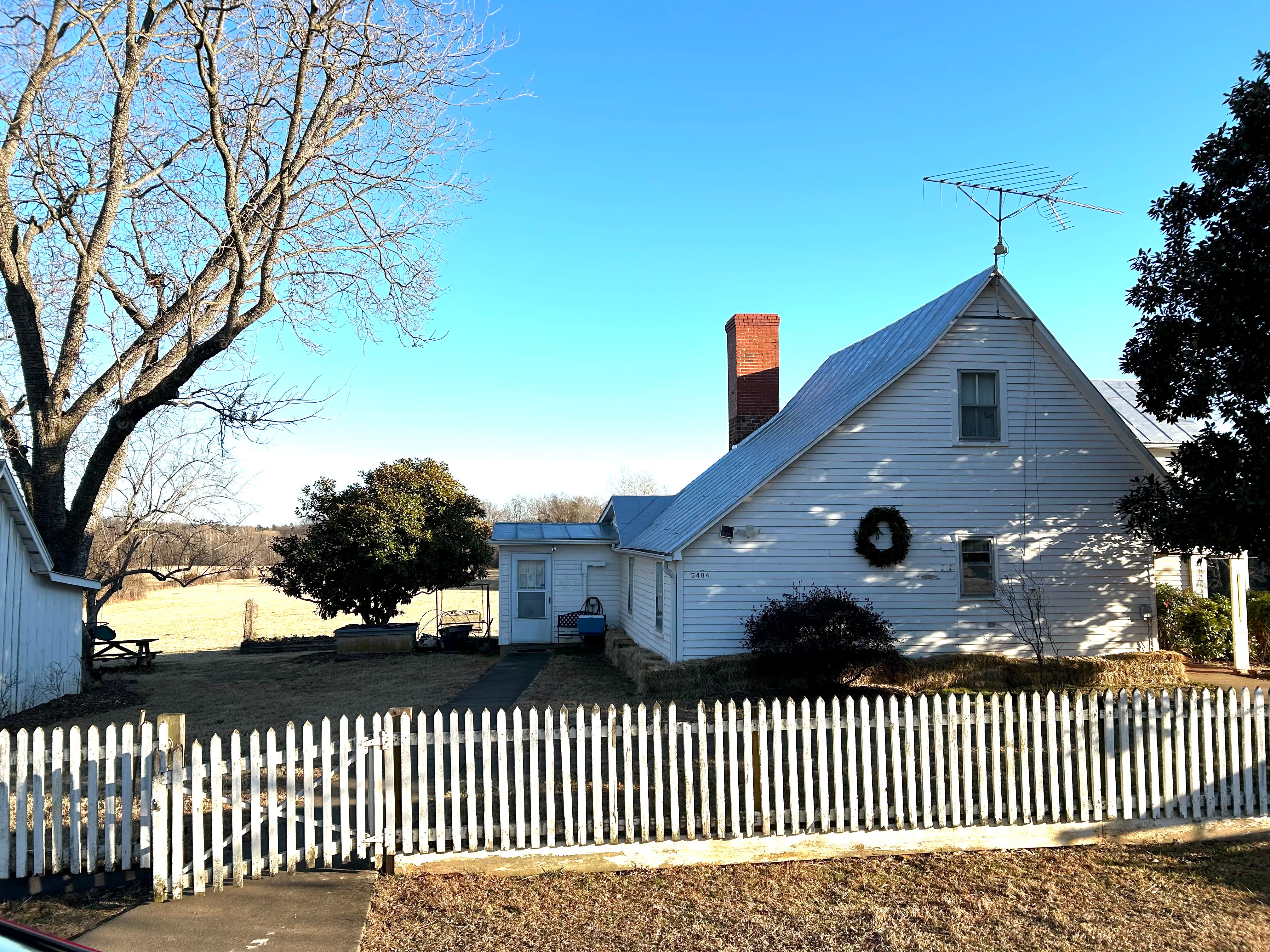
I located the original home of the family, still standing since 1776, in the northwest corner of Orange County, Virginia, along the Rapidan River.
The skinny:
In 1767, my aging sixth great-grandfather John Conyers White purchased the 356 acres that he had been leasing.
It is fertile river bottom land, acreage that held for more than a century that “hideous blot” on our American experiment as Thomas Jefferson himself called it:
Enslaved human beings who worked our family’s tobacco fields.
And to boot, White bought the land from future president James Madison’s father, both of whom were slaveholders as well.
Nine years later or so, in 1776, White or his sons built the house, today called Carolton, that I recently located after receiving a book in which a photograph of the house appears.
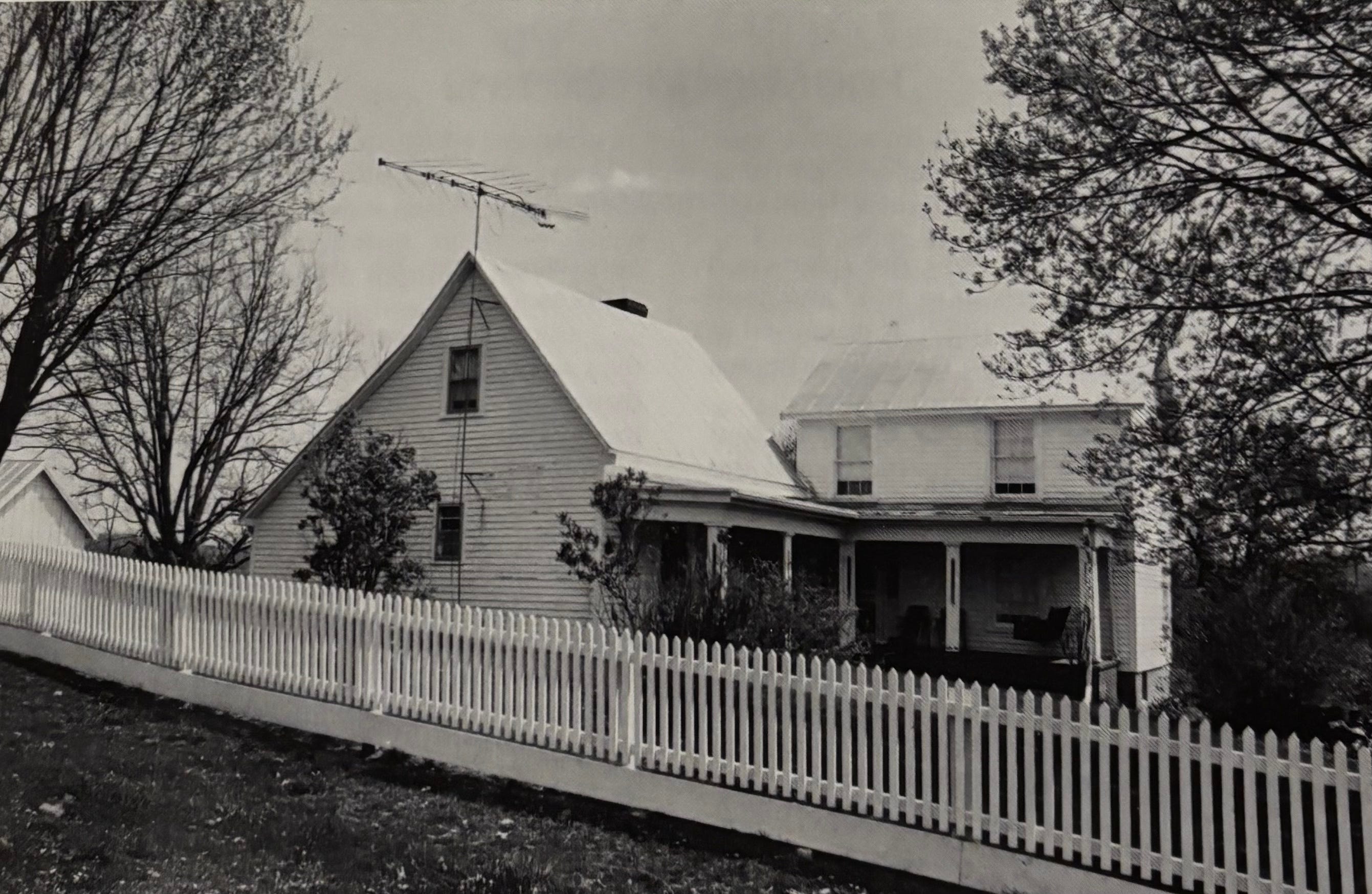
Using the internet and the telephone, I contacted the home’s current owners and occupants who were surprised to hear of someone interested in the old place.
“It’s a wonderful house,” says the current occupant, Barbara K. Tinder, whose husband agrees.
Gordon Tinder’s grandfather John Colvin bought the place in 1915 and his mother, who died recently at 103, was born here.
In his 70s, he was on his way to get some photographs of the old family cemetery when we hung up.
As astonishing as finding the house still standing today is that our ancestral lands also contained, from the beginning, the symbolic second “hideous blot” on our country—its treatment of Indigenous peoples—in the form of an “Indian graveyard.”
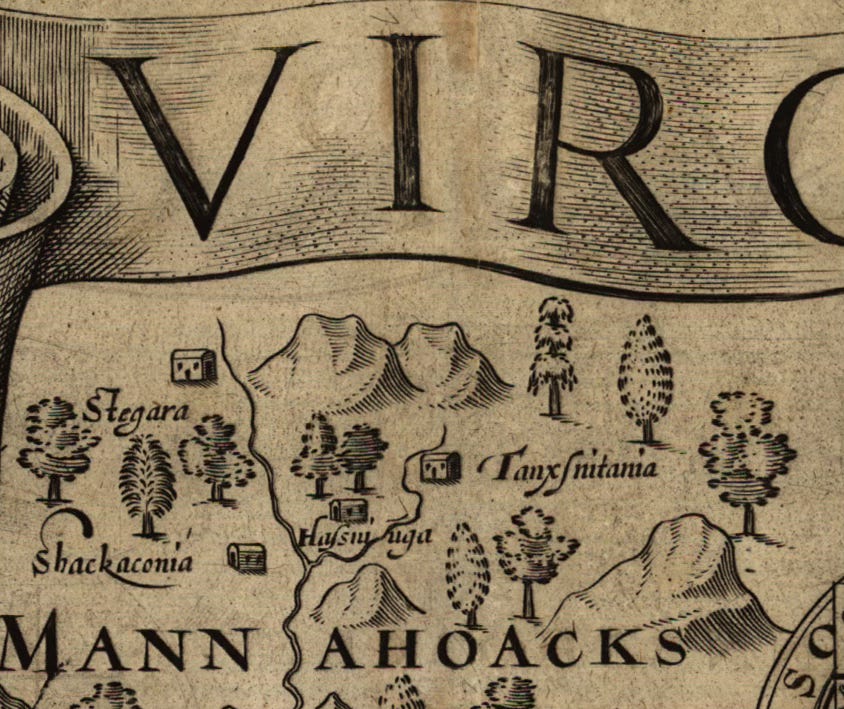
It’s an ancient burial mound, known as the Rapidan Mound, and the village called Stegara, of the Manahoac peoples—a group of Siouan-speaking Native Americans who hunted, traveled and flourished between 600 and AD 1600.
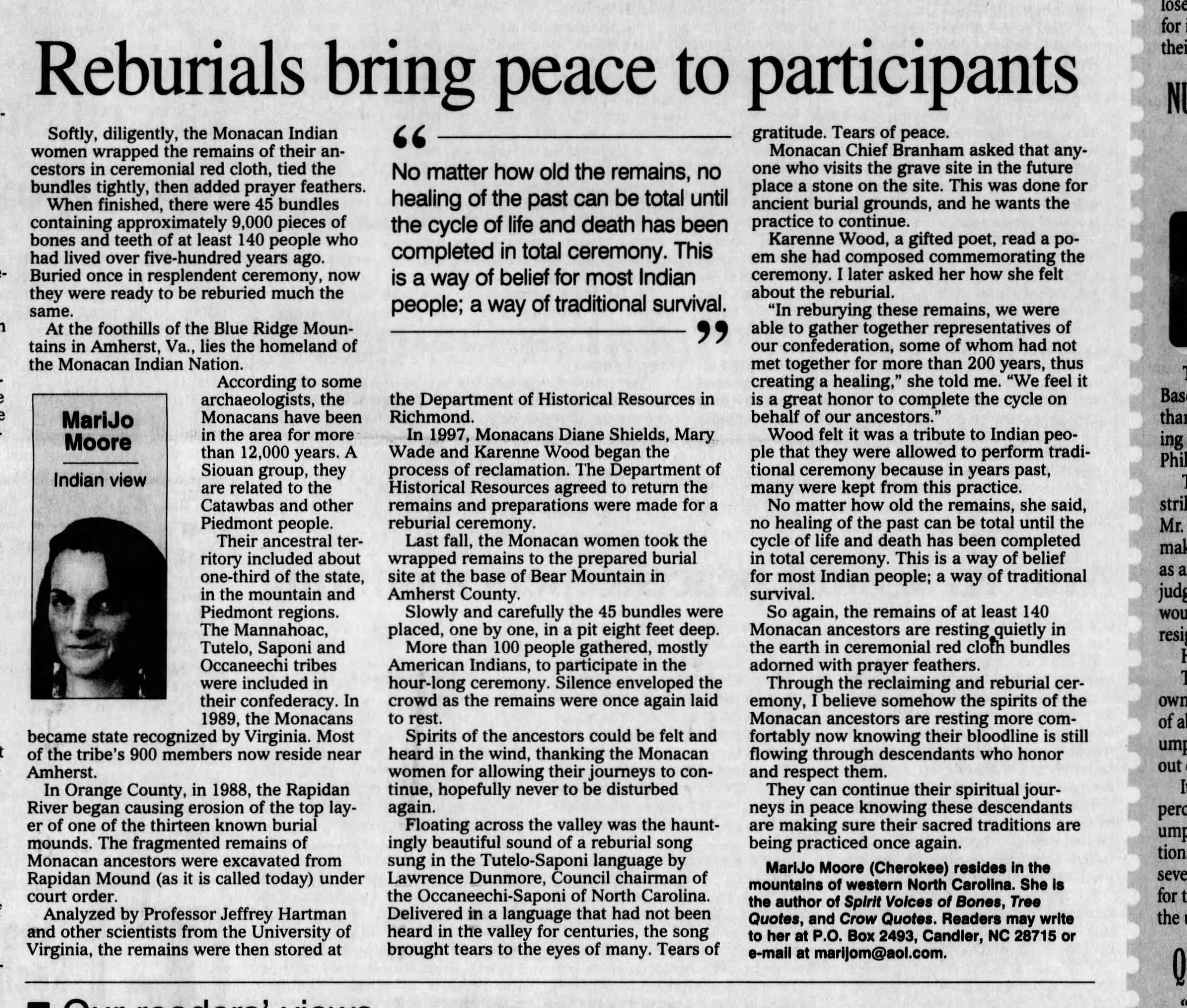
It has been studied by archeologists since the 19th century, and more recently, the tribe acquired 9,000 bones that had been excavated over the years at the site and reburied them, with ceremony, in nearby Amherst, Virginia.
(See article below in The Great Falls Tribune.)
“There’s quite a lot of information out about the Mound,” Barbara said. “There were three of them and they have mostly been washed away by the river.”
She said the village of Stegara is underneath the fields right out their front door.
In the last day, I’ve written the Wikipedia page for the mound site and current community Scuffletown.
As important, I am posting a memorial this MLK Day for what I believe were among the first documented enslaved people with whom my great-grandmother’s family associated.
[She, by the way, was a sweet lady with delicate, wrinkled hands, Olive Pearl White Lineberry, who died when I was ten years old. Her father, James Early White, Jr., was a Civil War veteran about whom I have written.]
I obtained the deed, dated 1750, from a hard-to-obtain genealogical book about the family, and with the help of AI, offer this:
Enslaved Persons Recorded in the White–Bramham Deed (Virginia, 18th Century)
This record is written to acknowledge and remember the enslaved individuals whose lives were documented only incidentally in colonial legal instruments, where they were treated as property rather than people. What follows restores their names where known and situates them within their historical reality.
Boatswain
Status: Enslaved child
Recorded: Orange County, Virginia
Date: August 23, 1750
Boatswain is identified in a deed as “a boy named Boatswain,” transferred as part of a legal transaction involving land and tobacco. No age, parentage, or origin is recorded. His name—likely imposed rather than chosen—reflects the maritime naming conventions often assigned to enslaved children and suggests a loss of original identity even before the document was written.
Boatswain’s life was bound by law to the will of others. He could not consent, refuse, or testify. His presence in the record survives only because his labor and future value were considered measurable and transferable.
Rose
Status: Enslaved woman
Recorded: Orange County, Virginia
Date: August 23, 1750
Rose is recorded as “a woman named Rose,” transferred alongside Boatswain. Under Virginia law at the time, Rose’s legal status meant that any children she bore would also be enslaved for life, a condition referred to in legal language as her “increase.”
Rose’s body was thus not only a site of labor but also of enforced reproduction, ensuring the expansion of enslaved property across generations. Her name appears once, without description, yet her life likely spanned decades of coerced work, survival, and resistance known only to herself and those who lived beside her.
Thirteen Unnamed Enslaved Persons
Status: Enslaved men, women, and possibly children
Recorded: Richmond County, Virginia
Referenced Deeds: August 1–2, 1721
The document also references “thirteen Negro slaves and their increase,” conveyed in earlier deeds. Their names were not recorded. Their identities, families, languages, skills, and histories were rendered legally invisible, though their labor sustained households, cleared land, raised crops, and built wealth.
The phrase “and their increase” signals that these thirteen were not only enslaved individuals but ancestors—people whose descendants were born into bondage without record or recognition.
Historical Context
In colonial Virginia, enslaved people were classified as chattel property. Legal documents routinely named landowners, witnesses, and officials in full detail, while enslaved people were named selectively or not at all. Naming occurred only when it served economic clarity, not human recognition.
That Boatswain and Rose are named at all is significant. Their names survive because they were newly transferred and needed to be distinguished as assets. The others, already held, required no such specificity.
Statement of Recognition
This memorial affirms that Boatswain, Rose, and the unnamed thirteen were people, not property:
They had inner lives, memories, relationships, and aspirations.
They endured a legal system designed to erase those truths.
Their forced labor and stolen futures contributed materially to the land, families, and institutions that followed.
Their names—spoken here—are acts of restoration.
May this record stand as acknowledgment that history was built not only by those who signed deeds and sealed documents, but also by those whose lives were bound by them.
Verbatim Transcription from August 23, 1750, copied by Thelma White on October 29, 1968.
Orange County, Va., Courthouse, Deed Book No. 11 – Page 215
To all to whom these presents shall come we JOHN WHITE of Prince William County in the Colony of Virginia and ANNE his wife send greetings know you that we the said JOHN WHITE and ANNE his wife for diverse good causes and considerations as thereunto moving but more especially for and in consideration of The sum of THREE THOUSAND pounds of TOBACCO to us well and sufficiently secured to be paid and two Negro Slaves a boy named Boatswain and a woman named Rose to us actually sold and delivered by John Bramham of ORANGE County in the colony (Va.) aforesaid the receipt of which slaves we do hereby acknowledge slave. Remised released and forever quit claimed and by these presents do remise release and forever quit claim unto the said John Bramham his heirs executors administrators and assign all and all manner of right title interest properly claim and demand in revision of us the said JOHN WHITE and ANNE his wife of in and to a certain tract or parcel of land with the appurtenances situate lying and being in Richmond County containing two hundred (200) acres be the same more or less, and of in and to all those thirteen Negro slaves and their increase mentioned and comprised in certain Deeds made between the said John Bramham and Anne his wife and one Samuel Godwin which Deeds bear date the first day of August 1721 and the second day of August 1721.
I do also acquit and discharge the said John Bramham and heirs of and from all and all manner of action suits and demands whatsoever of for touching or concerning the said lands and tenement to slaves and their increase and every part and parcel thereof.
In witness whereof we the said JOHN WHITE and ANNE his wife have hereunto set our hands and seals this twenty-third day of AUGUST in the year of our Lord one thousand seven hundred and fifty (1750).
Signed, sealed and delivered the word made, being first Interlined in presence of us.
JOHN WHITE ANNE WHITE X her mark
L Lewis
W. Thipell
Thos W. Thorn Jr.
At a court held for ORANGE County on Thursday the 23 day of August 1750 this deed was acknowledged by JOHN WHITE and ANNE, his wife parties thereto and ordered to be recorded, previous to which she was privately examined as the law directs.
Test.
George Taylor.
Also included in today’s remembrance are the following humans.
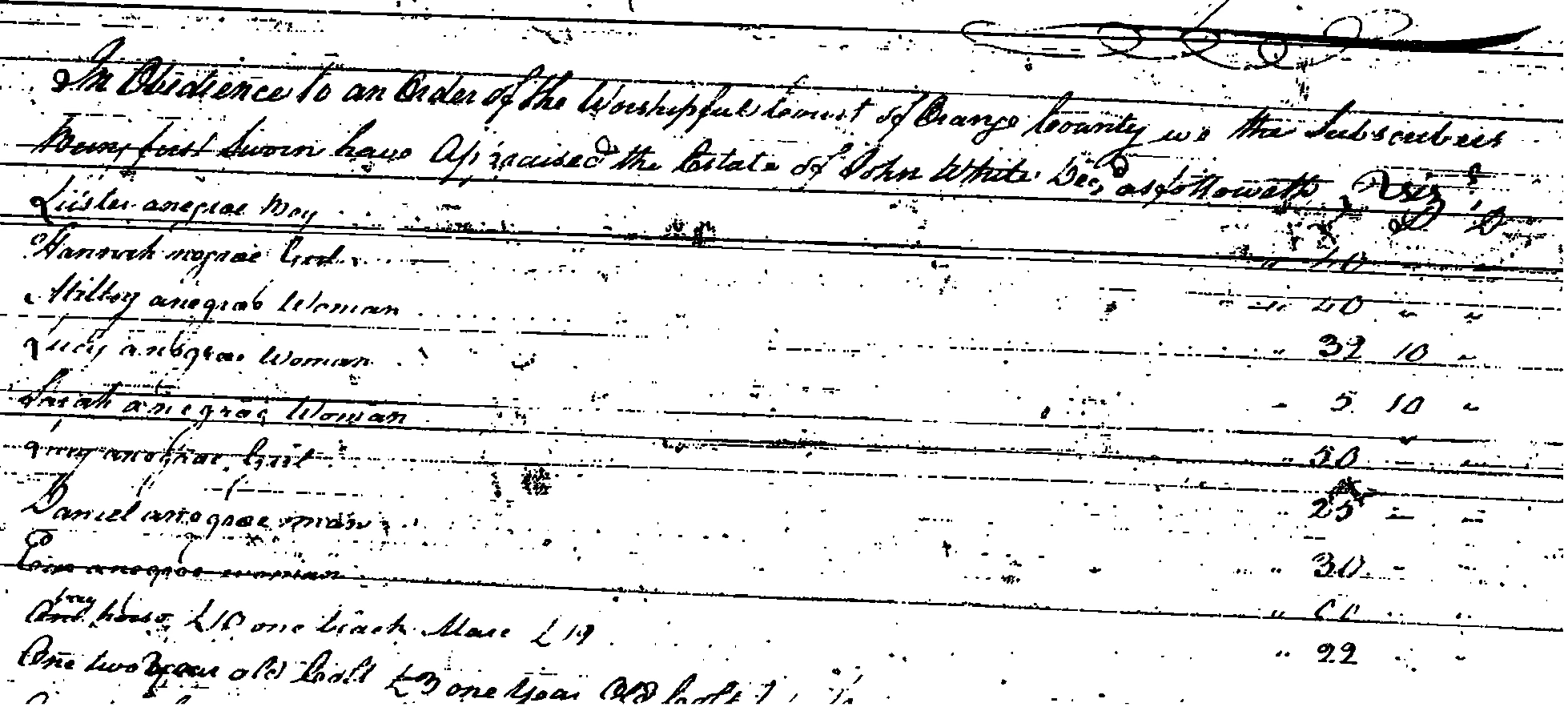
By the year 1782, John White and his wife Ann owned seventeen human beings, who were unnamed in the census.
After his death in 1787, the inventory taken April 28, 1788, (pictured) catalogued the following twelve human beings:
James.
Rich.
Doll.
Esther.
Luster. (a boy) £ 60
Hannah. (a girl) £ 40
Millay. £ 32.10
Lucy. £ 35.10
Sarah. £ 50
Lucy. (a girl) £ 25
Daniel. £ 30
Eve. £ 00
Great article and sad realization my ancestors were holders of so many slaves.
Thank you so much for sharing your families’ past with us, Michael, and on this day where we honor Dr. King, and his legacy and experience. I am grateful that we can learn to change from the horrors of our past of owning and enslavement of other human beings.